
Entity Structure
LLC vs. S Corporation: What Business Owners Should Review
'Should I be an LLC or an S-corp' is one of the most common questions owners ask, and it's slightly misframed. LLC is a legal entity. S-corp is a tax election. An LLC can elect S-corp tax treatment. Here's how the comparison actually works.
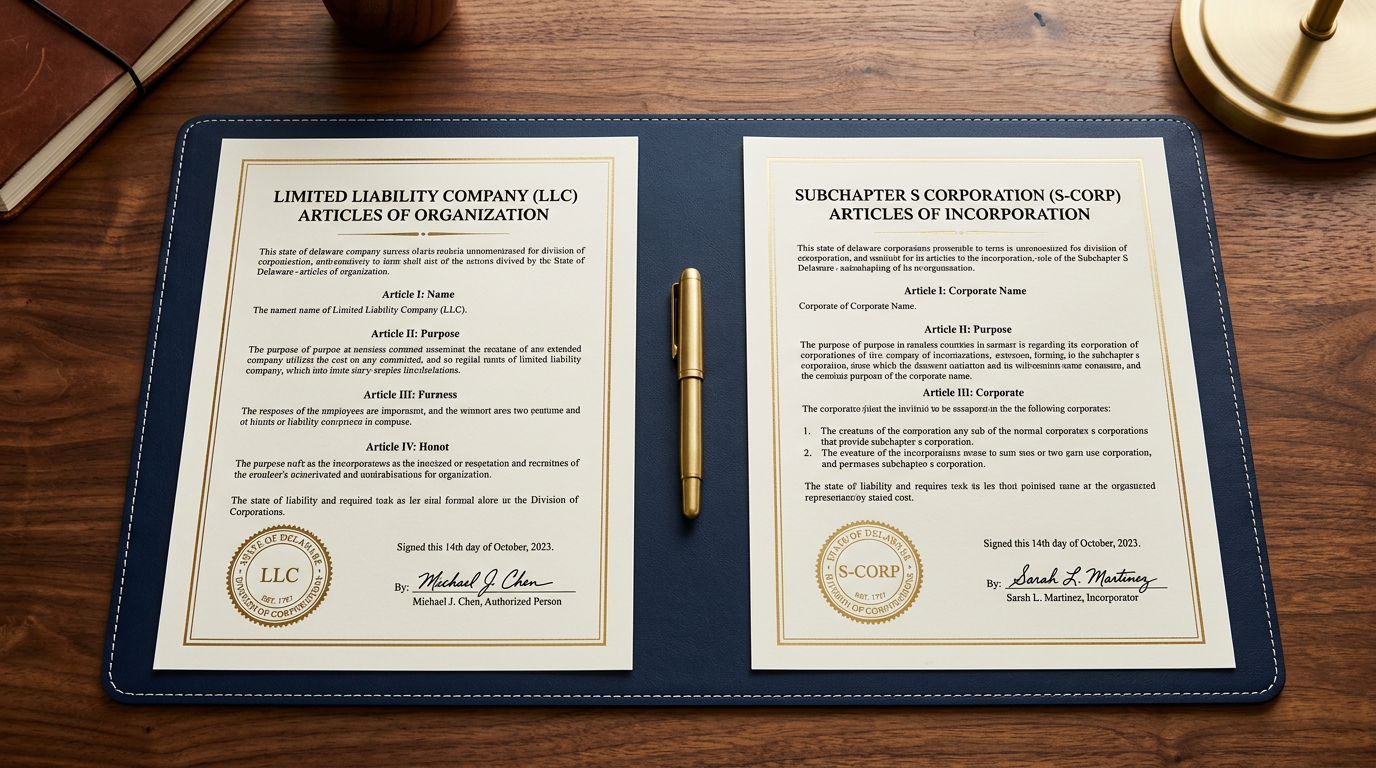
The legal layer
An LLC is a legal entity formed at the state level. It provides liability protection and operational flexibility. A corporation is a different legal entity with stricter governance (board, officers, bylaws, minutes).
Most small businesses operate as LLCs because the legal flexibility is better.
Prefer to talk this through? Book a free consultation → or learn more about Tax Planning & Advisory.
The tax layer
An LLC, by default, is taxed as a disregarded entity (single member) or partnership (multi-member). An LLC can elect to be taxed as an S-corp by filing Form 2553. A corporation is, by default, a C-corp but can elect S-corp treatment.
Default LLC vs LLC taxed as S-corp
Default LLC: all profit subject to self-employment tax. S-corp election: profit split into reasonable salary (SE tax) and distributions (no SE tax). For owner-operators above ~$80K, the election usually saves more than it costs.
What stays the same
Liability protection. State filing requirements. Bank account separation. Operational flexibility. The legal entity doesn't change when you elect S-corp treatment.
When the default LLC is better
Low profit (< ~$60K). Real estate rental income (which isn't subject to SE tax anyway). Businesses with foreign owners or trust owners (which can't be S-corp shareholders).
Want to apply this to your situation?
Book a consultation with a Kuuni Partners advisor — Georgia-based, serving clients nationwide.
Related services
More in Entity Structure
Entity Structure
S-Corp Election: When It Saves Money (and When It Doesn't)
A practical breakdown of the math for $60K–$400K owners.
Read more →Entity Structure
Reasonable Compensation: How the IRS Decides
What 'reasonable' actually means and how to defend it.
Read more →Entity Structure
Holding Company Structures for Multi-Entity Owners
Asset protection, tax efficiency, and clean reporting for multi-entity owners.
Read more →